
Tänk till! is a quiz card game made by Tänk till! UF, a student company at Midsommarkransens Gymnasium in Stockholm. The team designed every card in Canva, checked the deck and its box in 3D in Printedin Studio, and had the games printed and boxed in time for the market in Kungsträdgården on 28 November. This is how it came together, and what we learned making it with them.
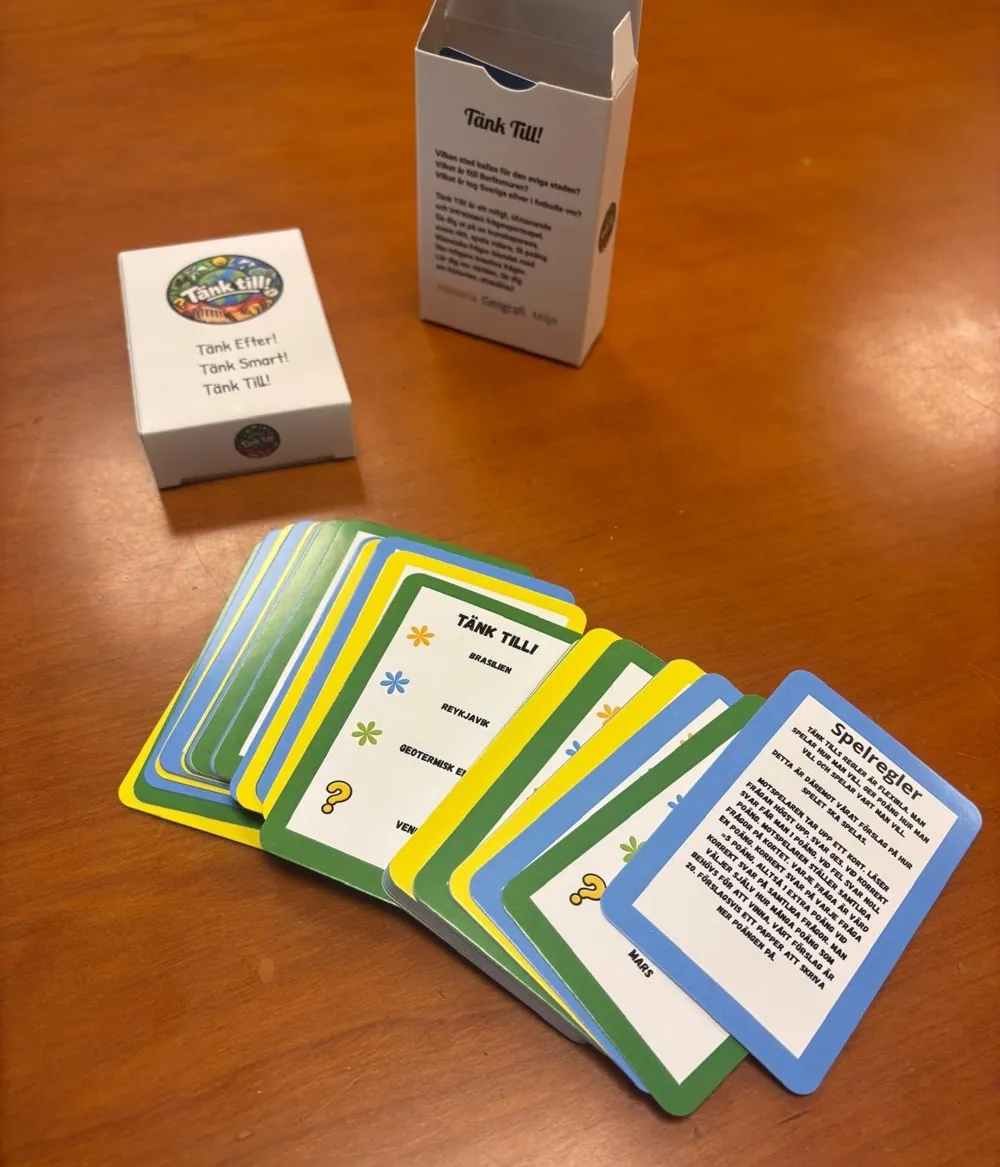
It started with a sketch
On a Friday in early October an email arrived from Tänk till! UF, a newly started student company at Midsommarkransens Gymnasium in Stockholm. In Sweden, the Ung Företagsamhet programme lets upper secondary students run a real company for a school year: they come up with a product, find suppliers, set their prices and sell to real customers.
Their idea was a quiz card game for young people, so that they could learn new things, and have fun doing it. The email came with a drawing of the game and a first version of the rules. "This isn't set in stone," they wrote, "just a first model." We liked it straight away.
Four questions, one card
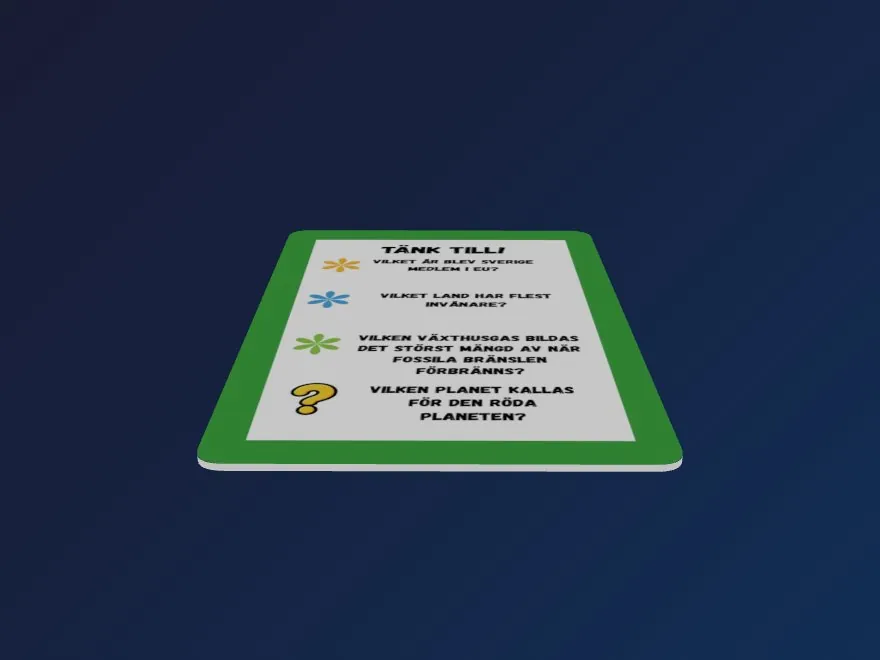
Every card in Tänk till! asks four questions, each marked with a coloured symbol:
- Historia: history
- Geografi: geography
- Miljö: the environment
- ?: a question of any kind
Your opponent draws a card and reads the first question. Answer correctly and you score a point and go on to the next one. Get all four right and you earn a bonus point. The answers are on the back of the card, so there is no arguing. And as the rules card says: Tänk till's rules are flexible. Play how you like, score how you like, and play wherever you like.
The name is a Swedish expression for stopping to think properly, and the box puts it three ways: Tänk efter! Tänk smart! Tänk till!
Smaller, simpler, easier to sell
The first plan had cards, a die to pick the colour and a cardboard box to hold it all. Within a week the team had rethought it: no die, no big box, just the cards in a small box like a classic deck of playing cards, with the description of the game on the back of the box. The cards got smaller too, down to the size of a regular playing card.
Every one of those decisions was a good one. The game became quicker to explain, easier to carry around a market and easier on a student company's budget, and it still had everything it needed.
Canva, PDFs and a deck in 3D
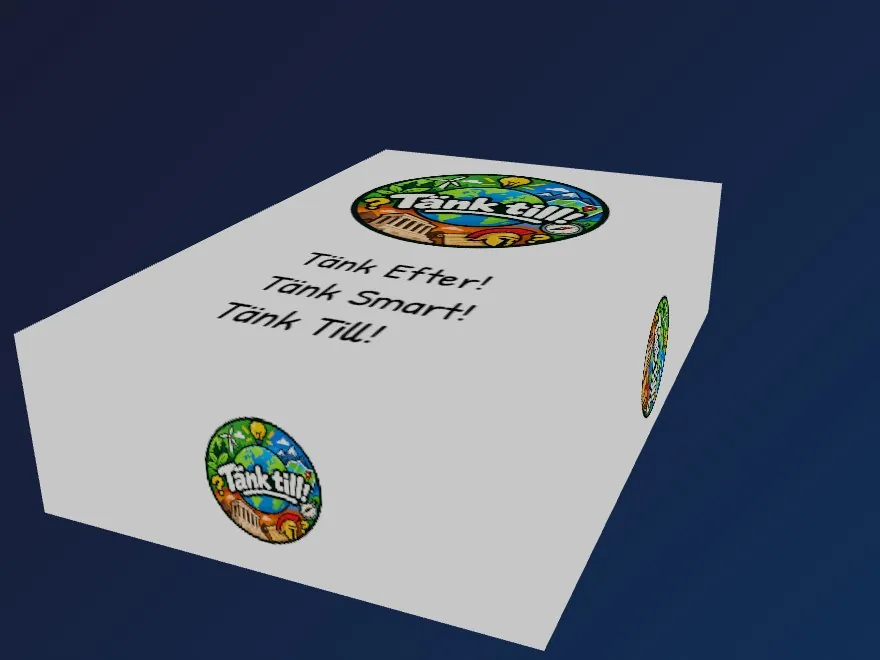
The team designed every card themselves in Canva, in between lessons. Whenever they had a batch ready they sent it to us as a PDF. We checked each card and put it into their deck in Printedin Studio, on their own account, so they could open the preview and see their cards and their box in 3D long before anything was printed.
Along the way we shared a few things printers think about and most people never have to. A coloured frame has to run past the edge of the card, or a thin white line can appear where it is cut. Text stays sharp when it is exported as text rather than as a picture. They sent a single test card first, "so I don't make them all again for nothing", and once it was right they made the whole deck the same way: first nine cards, then twenty-one in a new, wider frame, then fourteen more, until the whole deck was done. "I'm powering through the cards," one email said. Our guide to printing your own card game walks through the same steps.
Easiest first
When the cards were finally finished, the team had one more question. The environment questions were the hardest, and they came first on every card, so many players would stop at the very first hurdle. Should they change the order?
We thought they were right. When you have to answer correctly to go on, it is best to start with the easiest question and end with the hardest: almost everyone scores a point, and the excitement grows with every question. After their next lesson the team reordered every card, front and back, and the hardest question became the finale.
The little things
Before anything went to print, we went through the box together. A couple of typos were corrected, the yellow of Historia became a little darker so it can be read on white, and the rules on the instruction card got a bit more room. We also suggested putting the logo on all four narrow sides of the box, so the game can be recognised however it stands on a shelf. The team kept them, and when we asked about the finish of the box, they chose matt.
One card, already on its way to print
Late one night, after the order had been placed, the team spotted a mistake: one question named the wrong person. It should have asked about her cousin. "We completely understand if it's too late to change," they wrote, "but it's always good to ask."
It wasn't too late. We corrected the card that same morning, and found a zero hiding in a word where an o should have been while we were at it. The team approved the new card within hours, and the corrected deck is the one that was printed. If something doesn't look right, it is always worth asking.
Behind the scenes
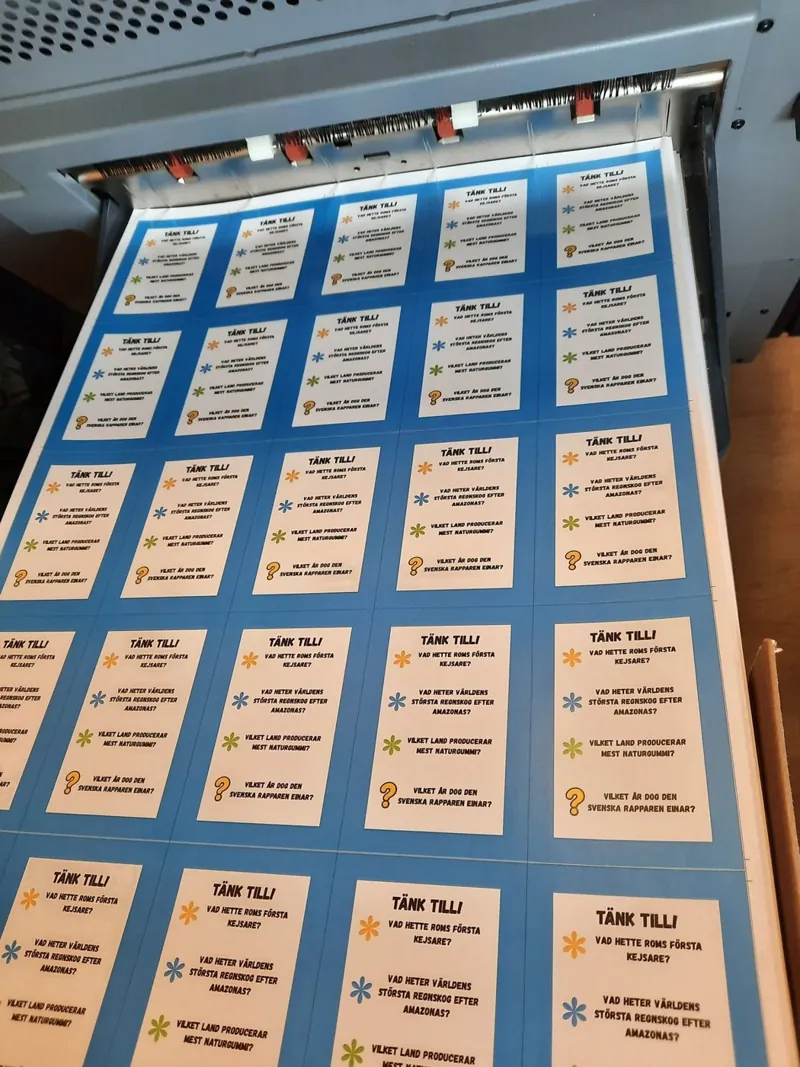
Once the order was placed, the team asked whether we could send them pictures of the process. Of course we could. Here is a little of what they saw.
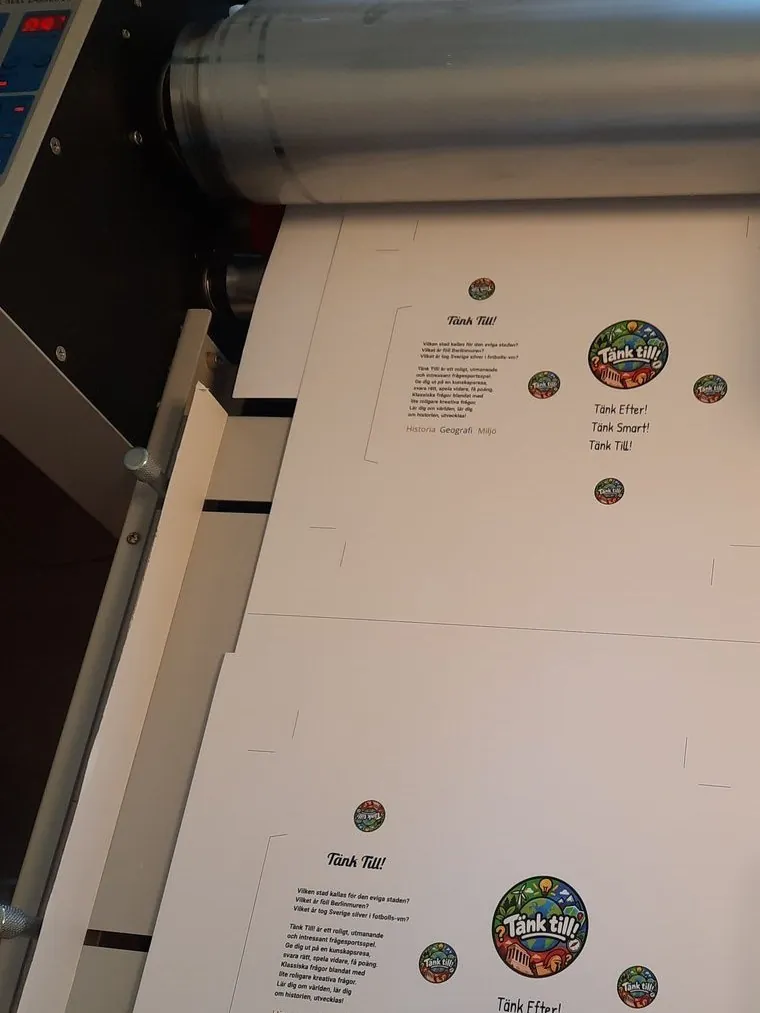
Ready for the market
The games were cut, put into their boxes and shipped eleven days before the big day: the market in Kungsträdgården on 28 November, the day the team expects to sell the most. When they saw the photos of the finished games, they wrote back the same afternoon.
Thanks for everything, from the help to the product development.
"Tack för allt från hjälp till produktutvecklingen."
Tänk till! UF, the day the games were shipped
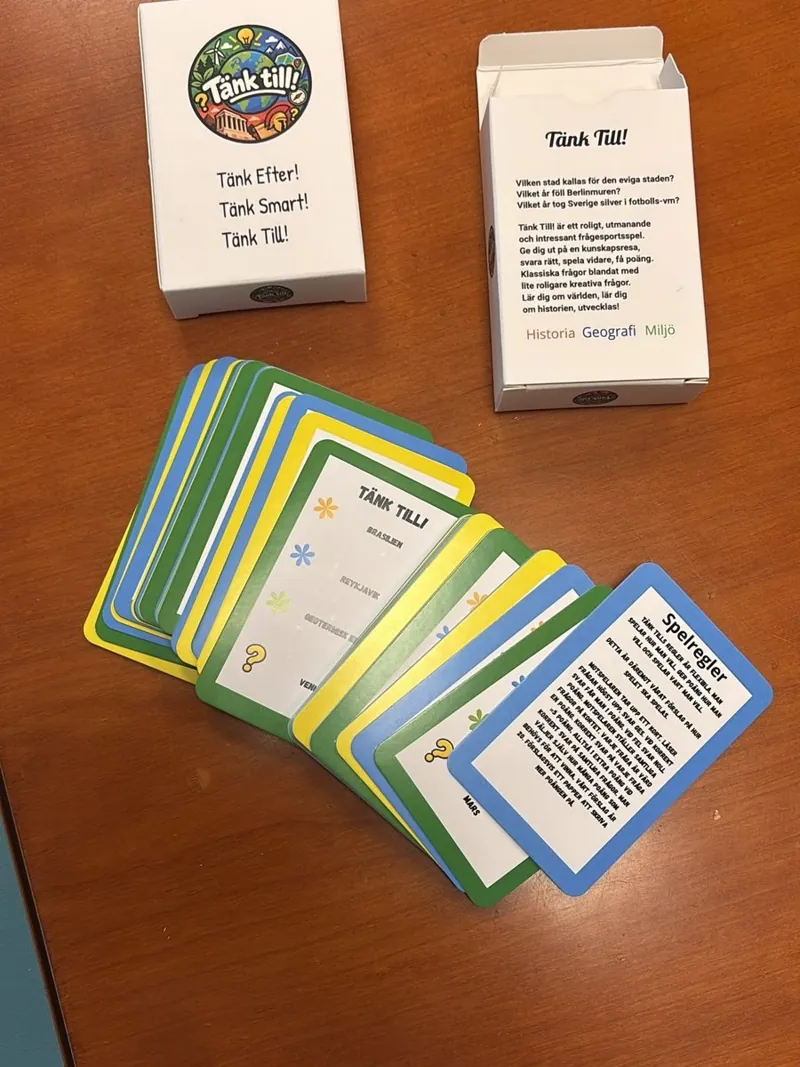
What comes next
On 28 November you will find Tänk till! UF at the market in Kungsträdgården. If you are in Stockholm, stop by their stand, pick up a card and see how far you get. And who knows: the team has already said they may come back for a second edition.
Thank you, Tänk till! UF, for letting us be part of your company's first product. It was a pleasure to work with you, and we wish you a great market day.
Are you running a student company, or do you have an idea for a card game of your own? You can design it in Printedin Studio, or write to us at support@printedin.com and we will think along with you.